|
19TH CENTURY CROW INDIAN SADDLE –
EXCELLENT SPECIMEN: These early Native American
saddles dating from the 19th Century simply
did not survive in large numbers.
Given their intended
use, the method and materials used in construction, and
the environment in which they were used, the true early
19th Century Native American Saddles are not found in
any significant numbers and those that do exist often
present in relic condition.
Many of the saddles were intentionally destroyed by the
army during the Indian Wars, along with the horse herds
and other captured camp equipage in compliance with the
established policies to deprive the free roaming native
people of their means of transportation and the
equipment necessary to maintain their way of life on the
plains. Once confined to the reservations and agencies,
the older styles and methods of creating the native
saddles were no longer necessary or were no longer
practical, and were replaced by the standard
contemporary saddles manufactured by the commercial
saddleries and obtained from the general stores around
the reservations. Hence, surviving specimens of these
19th Century saddles crafted by the Plains
tribes in the traditional fashion are fairly scarce and
are actively sought after by today’s collectors.
This is a
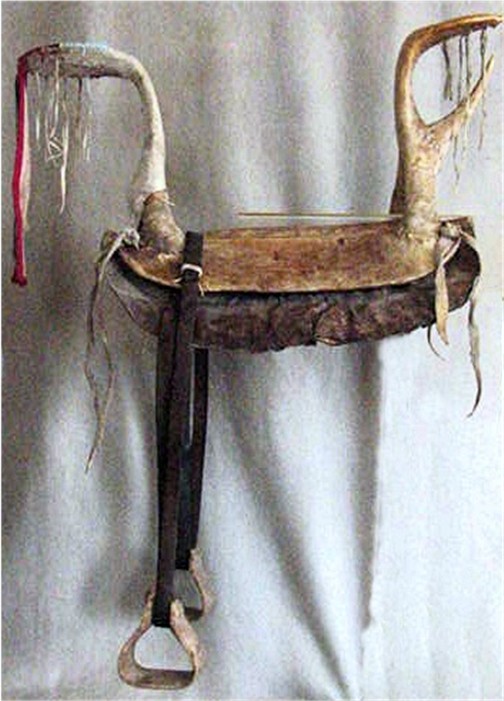
particularly nice example of an Absaroka, or Crow,
Saddle - one of the classic designs originating on the
Northern Plains and the Plateau which has become one of
the most iconic designs of Native American saddles.
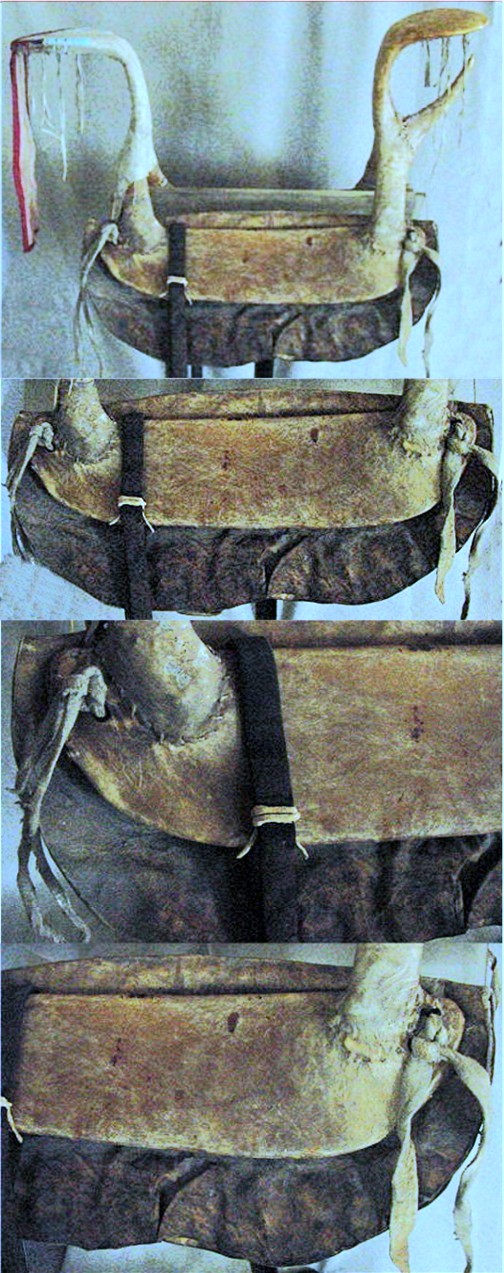
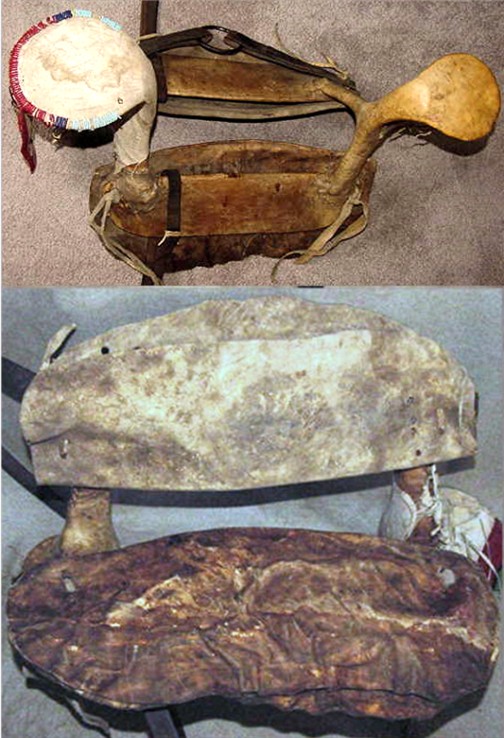
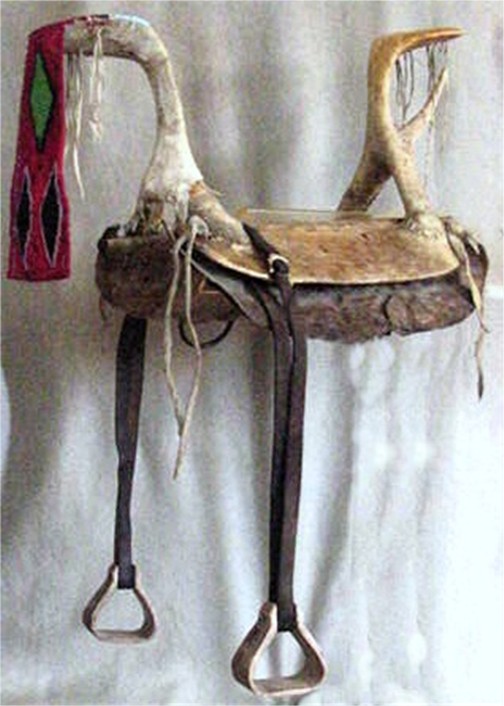
Constructed of hand fashioned wood, the
four pieces of the frame – the pommel, cantle and two
side bars – are solid and intact, and the face of the
cantle has the classic additional baggage hook.
Measuring
26” long across the
top flats and 18 ½” along the side bars, the pommel and
cantle top flat caps are 15” high, and the seat measures
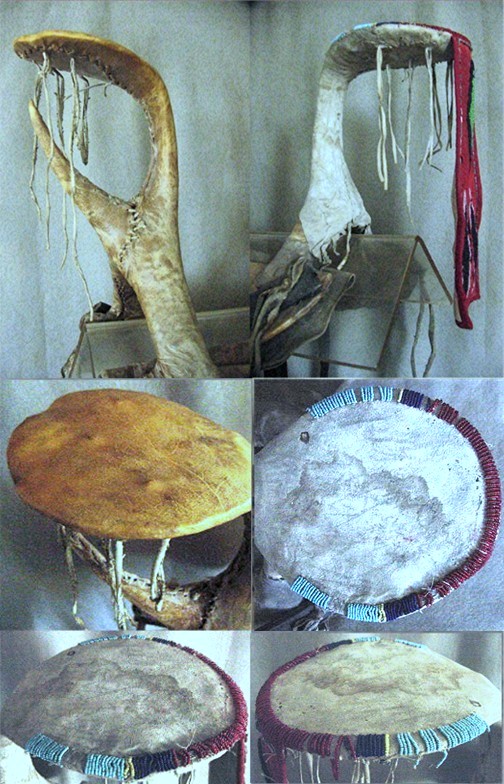
12” between the two uprights. The pommel cap measures
6” in diameter, and the cantle cap measures 5” in
diameter, and both are decorated with buckskin thongs
hanging from the underside of the caps.
The pommel arch and flat cap are covered in brain tanned
buckskin. The edge of the cap is decorated with a
single row of beadwork which is mostly intact with some
expected bead loss consistent with age and use.
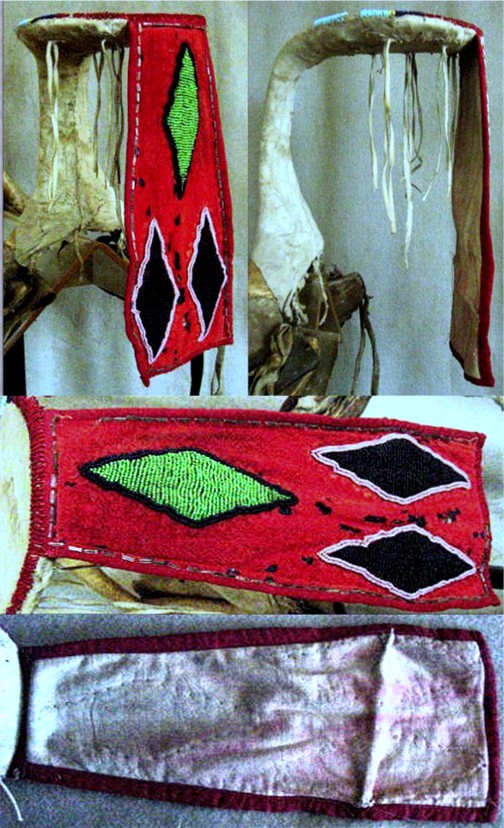
Depending from the front of the pommel cap is a
trapezoid shaped piece of red wool, backed with white
cotton drill, measuring 12” long, 3 ½” wide at the top,
and 5” wide at the bottom. The drop is edged with red
cotton binding and clear glass tube beads, with some
minor loss of the tube beads at the bottom edge. The
red wool field is beaded with three large diamond-shaped
beaded elements – the top green with dark blue edging,
and the bottom two dark blue edged in pink - a classic
combination of Crow design and colors. These three
beaded elements are fully intact. The red wool has some
mothing and is lightly soiled – both consistent with the
piece’s age and wear, but the material is still strong
with no loss of integrity.
The frame is
very solid with no loose joints. The
wood frame is covered in very old light weight rawhide
and all of the seams are sewn with sinew.
The rawhide covering
is in excellent condition without any tears and all of
the seams are intact. At both the front
and rear extensions of both side bars there are pairs of
the properly hand burned holes for the attachment of the
girthing straps.
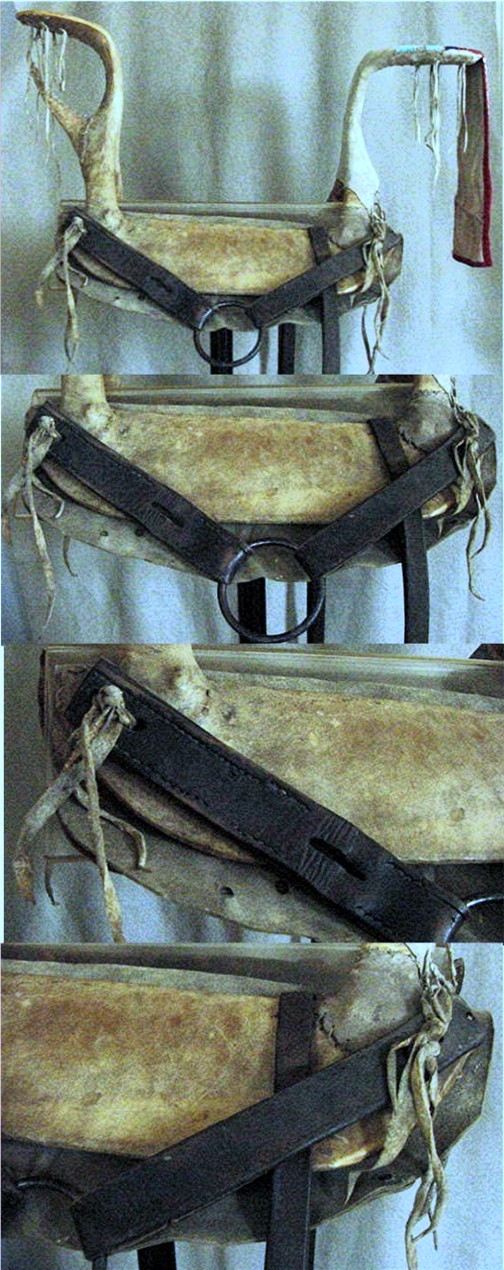
On the right side of the saddle the two original bridle
leather girthing straps are present, depending down from
the side bars to a 3 ½” iron ring. The straps show
aging appropriate to the saddle and from all appearances
are original to the saddle. The straps are attached
with heavy native tanned buckskin thongs, and based on
the weight of the hide they are quite likely buffalo
hide. Matching thongs are also present in the
corresponding holes on the left side of the saddle.
In addition to being the points of attachment for the
girthing straps, these four thongs also serve to anchor
commercial tanned heavy double layer leather jockeys –
or abbreviated skirts – to the underside of both
sidebars which provided additional bearing surfaces
which distributed the weight of the saddle and rider,
and provided additional cushioning.
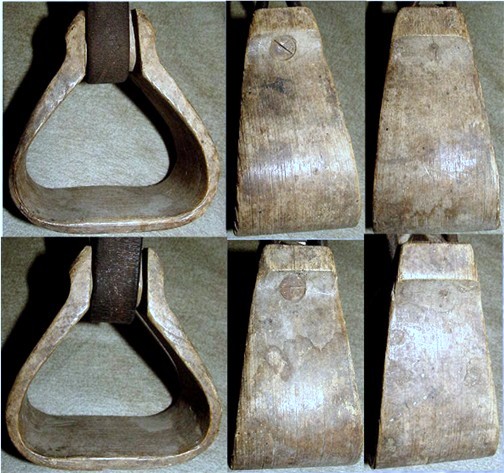
This saddle retains the original matched pair of wood
frame stirrups which were found intact with the saddle.
The stirrups are full form with no splits or loss of
wood. While the stirrups may appear undersized for the
size of the saddle, keep in mind that the stirrups were
intended to only accept the rider’s foot up to the ball,
not buried up to the arch as most modern riders prefer.
By only accepting the front half of the foot, the slick,
heelless soles of the moccasins were less likely to
slide through the tread resulting in a foot being
trapped in the stirrup. The stirrups depend from old
harness leather straps, tied in place with buckskin
thongs. The presence of the original stirrups is an
unusual feature as the stirrups on these Native saddles
were usually separated from the seats long ago, and that
they have survived with this saddle is a real added
value.
The feather weight of the wood frame and the parchment
like character of the rawhide, both having been well
seasoned through the last 125 plus years, provide ample
testimony to this saddle’s age and authenticity.
On its own merit, this
unique piece stands as a testament to the historic
Native Horse Cultures of the Western Plains, and it
presents very well as a
spectacular example of
pure Native American sculpture.
Included in a collection of US military saddles, Indian
War period accoutrements and weapons, or Native American
artifacts, this saddle would be a poignant addition to
your display. I sought such a saddle for many years to
add to my collection and today that Cheyenne saddle is
the first piece of horse equipment that visitors
notice. I cannot emphasize how difficult these saddles
are to find, particularly in this especially nice
condition, and when they are available, they seldom last
very long on the market.
(0704) $3450
|