|
19TH
CENTURY POMMEL “CALIFORNIA” OR “HORN” RIFLE LOOP – VERY
RARE WESTERN FRONTIER ERA FIREARM AND SADDLERY
ACCOUTREMENT – EXCELLENT CONDITION:
This is an especially nice very
rare surviving specimen of a Pommel Rifle Loop, also
known as a “California” or “Horn” Loop. This is not only
a well documented specimen, having been published in
Packing Iron by Richard Rattenbury, it may very well
be a unique one of a kind surviving example from the
post-Civil War years on the Western Frontier.
For as long as memory served, men mounted on horseback
had carried their weapons balanced across their lap, the
pommel of the saddle, or the horse’s neck, and this
practice was particularly common in the 19TH
Century American West. It was a natural posture as the
weapon was kept in hand, ready to be employed, while the
rider did not have to bear the weight in his hand or
suspended from his body via a sling arrangement.
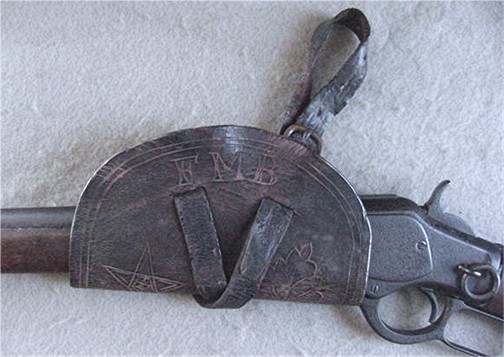
This rare surviving example of the saddler’s craft was a
fairly simple, but very effective design. The loop
allows the rifle to seat deep enough to secure it in
place, as well as being close at hand for the rider to
steady the load when necessary or draw the rifle when
needed.
Despite the rarity of surviving specimens in modern
collections, the use of these Pommel Loops must have
been fairly wide spread as they appear in a number of
period photographs and contemporary artwork created
during the
Frontier Era.
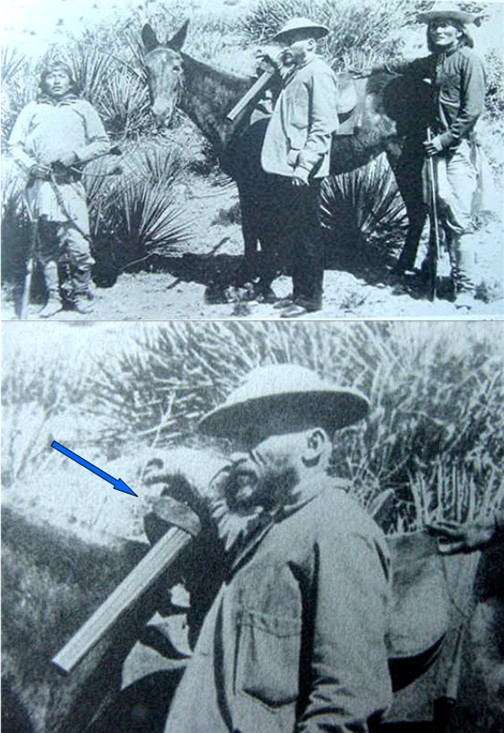
BRIGADIER GENERAL GEORGE CROOK,
APACHE CAMPAIGN, ca. 1880’s
*************************
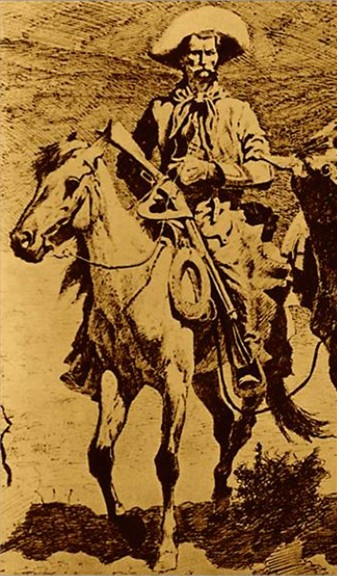
FREDERIC
REMINGTON,
HARPERS WEEKLY,
CA. 1890
*************************
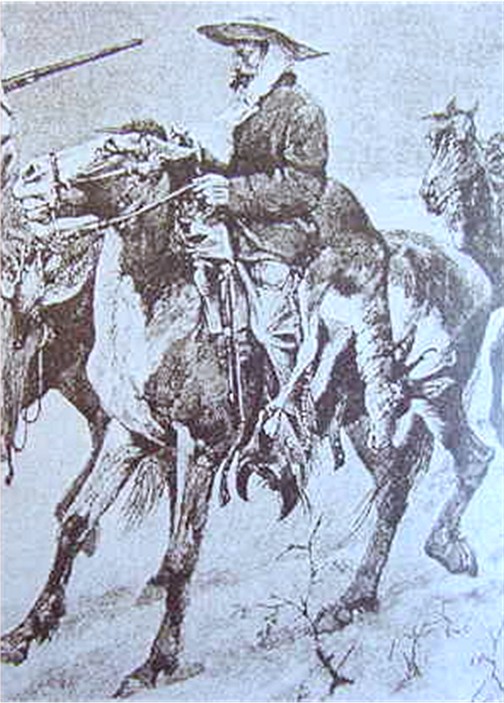
FREDERIC REMINGTON
“BRINGING HOME THANKSGIVING DINNER”
*************************
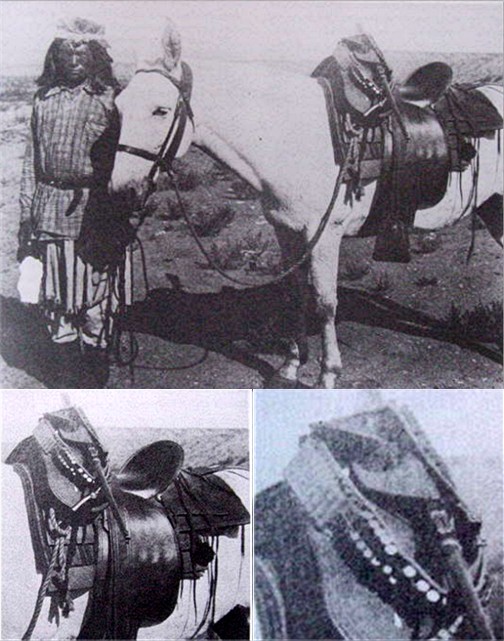
APACHE
SCOUT WITH LT. BRITTON DAVIS'S MULE
GARAVAGLIA & WORMAN'S
FIREARMS OF THE AMERICAN WEST VOL. II,
PAGE
37
*************************
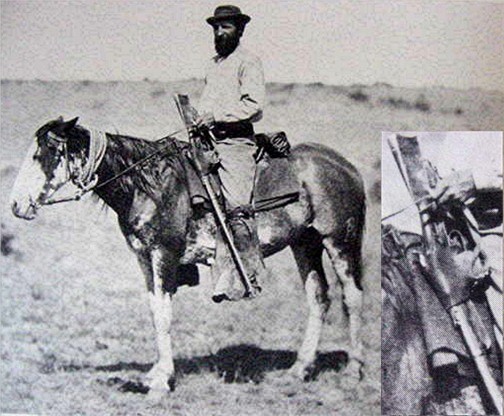
SMITH, TOPOGRAPHER, 1871 GEOLOGICAL
SURVEY
WORMAN'S SADDLE LEATHER & GUNSMOKE, PAGE 338
The evident popularity of the design notwithstanding,
surviving examples are all but nonexistent, making this
California Loop a very rare offering.
That more of them did
not survive suggests they were considered so common
place in the period of use that no effort was made to
preserve these loops in the manner in which holster and
cartridge belt sets were kept. And too, once the loops
wore out or were no longer needed in their original
form, the piece of leather from which they were formed
was large enough that it could be repurposed for other
needs.
Its worthy of note that
Phil Spangenberger, well known chronicler of the Western
gun culture, published an article “Rifle Packin’ in the
Old West” in the July, 2007 issue of True West
magazine. The article featured the use of Pommel Loops
in considerable detail, however with all of his
resources Phil did not have access to an example of an
original Pommel Loop to include in his article.
The concept of the Pommel Loop also caught the attention
of the US Army serving on the Frontier. The army
convened an Equipment Board in July of 1879 to consider
improvements to various pieces of equipment, and
entertained samples of innovations submitted by officers
and enlisted men alike.
One recommendation issued
by the Board was the adoption of a “Carbine Loop” which
allowed the soldier to carry his carbine across the
pommel of his saddle.
The Carbine Loop was
included in the description of the Whitman Saddle, “…
carbine loop, of the pattern submitted, to be attached
by buckle and stud to pommel.” Unfortunately, the
“pattern submitted” is not known to exist, however Randy
Steffen provided several interpretive depictions in The
Horse Soldier, Volume 3.
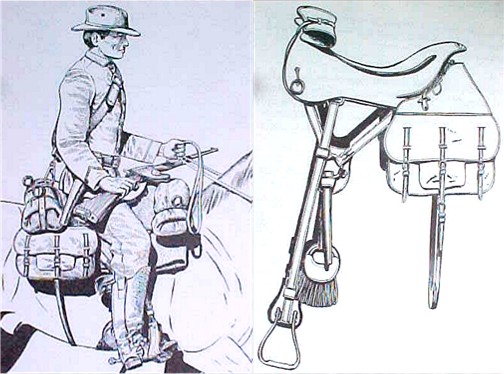
RANDY STEFFEN
THE HORSE
SOLDIER VOL. III
Despite all the endorsements the board’s recommendations
received, due to a lack of funding Secretary of War G.
W. McCrary refused to approve the production of the new
equipment, including the Carbine Loop, stating, “No
changes will be made at any time which involve an
expenditure not clearly within existing appropriations,
and great care will be taken to avoid a deficiency.”
There would be no funding for most of the changes
recommended, but the seed had been planted and soldiers
being soldiers - then as now - the idea of a Pommel Loop
had taken root in the ranks of the army.
Five years later another
equipment board would approve and adopt the Model 1885
Carbine Boot, and it was manufactured at the Rock Island
Arsenal, and issued, in significant numbers. That the
new boot was intended to be attached to the troopers’
saddles so that the carbine was carried muzzle down
along the troopers’ right leg is well documented, and no
doubt that is how it was employed by the majority of
soldiers. However specimens of the Model 1885 Carbine
Boot, modified to configure them to be used as a Pommel
Loop, have revealed that the concept of the Carbine Loop
had not been forgotten and at least some unit saddlers
and soldiers pressed forward with the concept.
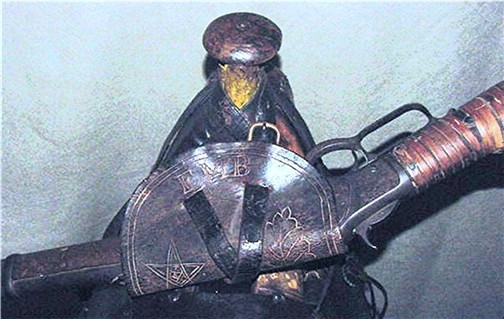
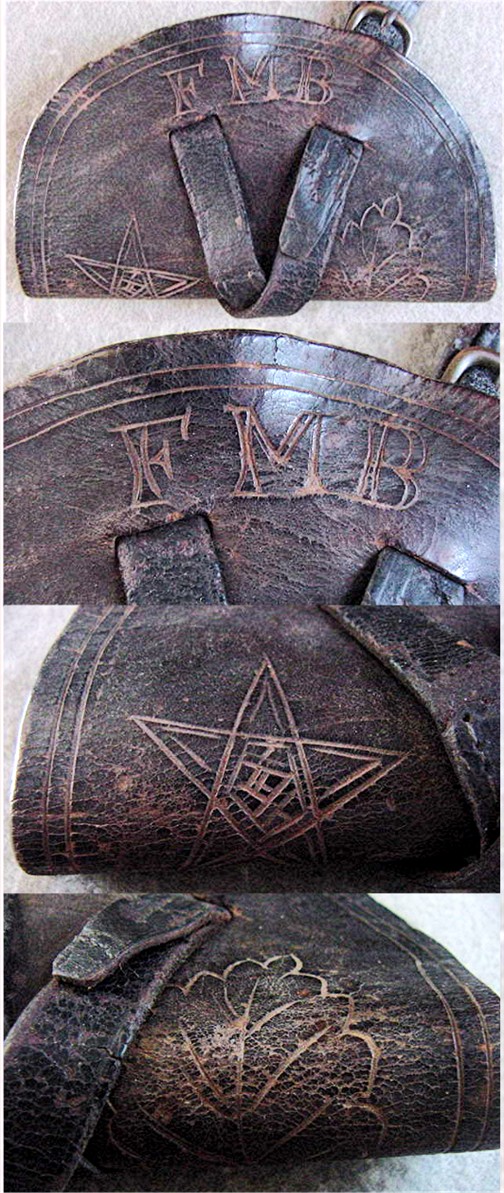
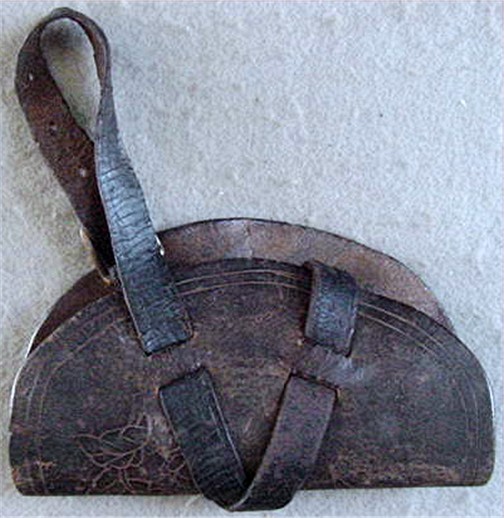
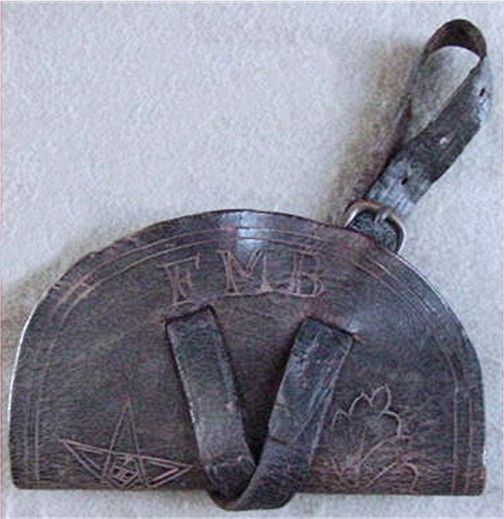
This Pommel Loop is fashioned from heavy saddle leather
and measures 7 ½” long along the fold and 4 ½” from the
fold to the crest of the curved upper edge,. Both sides
of the outer surface are decorated with a carved double
line border, a carved five point star and a carved leaf
and floral pattern, and a set of carved letters, “F M
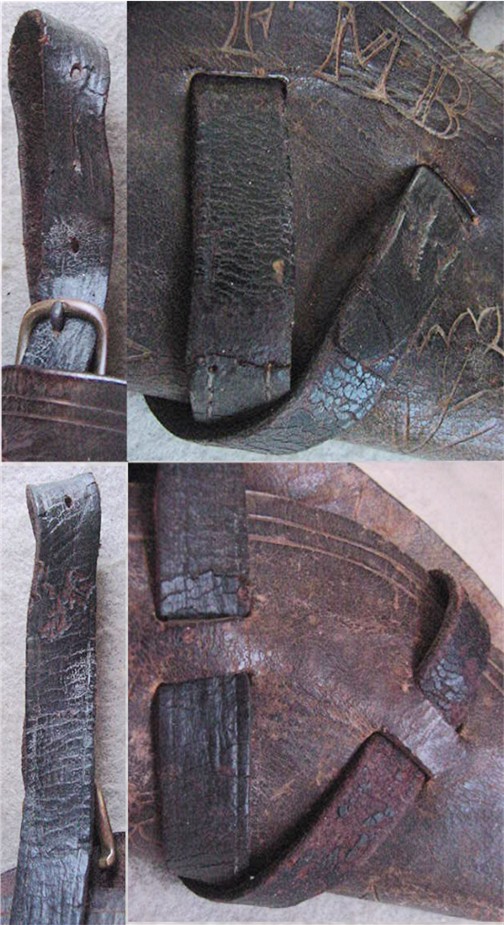
B”, likely the owner’s initials. Through slots cut in
both sides of the loop is a ¾” wide bridle leather strap
is threaded and arranged around the loop in a basic
figure eight pattern which allowed the loop to be
tightened around the form of the rifle to secure it in
place. The body of the loop is pliable, has not
hardened through age, and still retains its body and
shape. There are no breaks, tears, or other damage and
the carving is still very legible. The strap is full
length, still pliable, and matches the color and
condition of the body of the loop, and from all
appearances is original to the loop. The strap is
fitted with a rounded brass frame buckle. There is an
area on the strap which is stitched, indicating the
strap was either repaired or lengthened, and both
sections of the strap as well as the stitches appear to
be original to the period of use.
The positioning, arrangement and length of the strap
provided for the loop to be laid across the saddle
pommel roll in front of the rider, with the strap being
of sufficient length to buckle around the pommel roll
and, if necessary, engage the equipment rings or anchor
points on the saddle.
While exhibiting
evidence of use, this Pommel Loop is in full form and it
is in excellent condition with a bright, smooth shiny
surface. The strap is supple with no weak points and
the buckle is present.
As stated above, this is a unique
specimen, quite rare, and literally one of kind. This
Pommel Loop is a historically important accoutrement – a
surviving example of how the mounted frontiersmen
carried their long guns in those years when having a
long gun close at hand meant the difference between life
and death. Whether displayed with a Plains Rifle,
Winchester, or Sharps, or on the pommel of a period
saddle, this Pommel Loop will be a key piece for your
collection.
(0611)
$3500
|