|
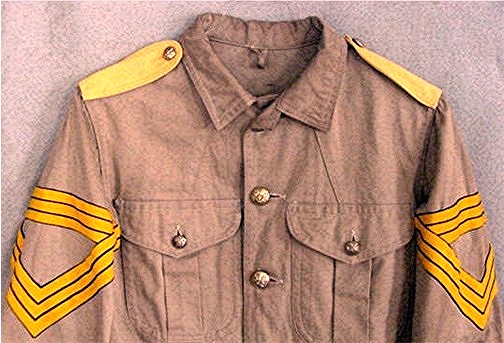
PATTERN 1899 CAVALRY QUARTERMASTER SERGEANT’S
TROPICAL UNIFORM BLOUSE COMPLETE WITH THE PROPER
SHOULDER TABS AND CHEVRONS – SCARCE EARLY KHAKI UNIFORM
IN VERY GOOD CONDITION:
At the start of the Spanish
American War, khaki colored, cotton uniforms were
adopted with the issue of General Order No. 39 on May 9,
1898 and were to be trimmed with the color of the branch
of service (G.O. 51, May 23, 1898) - dark blue for the
staff departments and general staff, yellow for cavalry,
red for artillery, and sky blue for infantry. The
blouses for the enlisted men had the trim colors on the
collar, shoulder straps, breast pocket flaps and cuffs,
and the officer blouses were trimmed in the branch color
on the collar, shoulder straps and cuffs.
While the colored trim provided an attractive and
distinctive uniform for each branch, the concept proved
to be “one of those good ideas that didn’t work”
for more than one reason.
The immediate problem became apparent when the colored
trim panels - especially the blue for infantry and red
for artillery – suffered from the severe tropical sun
and faded to some fairly unattractive anemic hues.
Additionally, as the uniforms were subjected to the
rigors of the field, the army quickly discovered that
the wear out period for cavalry and infantry uniforms
was considerably shorter than it was for artillery and
staff department uniforms. This resulted in a serious
shortage of replacement uniforms for the mounted and
foot troops, while an overabundance of artillery and
staff uniforms sat unissued in storage. Due to the way
in which this pattern of coat was trimmed, changing the
color of the facings in order to meet the need for
uniforms was not practical.
As a result, less than two months later, on July 15,
1898, the Secretary of War issued a circular directing
that while the design of the uniform blouse would remain
the same, the colored facings would be eliminated and
replaced with colored detachable shoulder tabs that
would be issued with the later pattern all-khaki coats
in the appropriate color for the soldier’s particular
branch of service.
The next phase in the evolution of a tropical weight
cotton khaki uniform occurred the following year with
the introduction of the uniform offered here, the
Pattern 1899 Tropical Uniform.
The standing collar of the
Pattern 1898 Blouse was replaced with a more comfortable
and less restrictive rolled collar. The waist belt was
eliminated, as was the pleat on the rear panel. The
lower pockets were moved from the hips to the front,
more or less in line with the breast pockets. The
colored shoulder tabs continued in use, designed to be
removable - easily replaced by the soldier and not
requiring the talents of a tailor. Like the Second
Pattern 1898 Blouse, the Pattern 1899 Blouse could be
issued to a soldier in any branch of the service, and
this amounted to a substantial cost savings. The
Pattern 1899 Blouse continued the use of the US Army
General Service Buttons used on the earlier khaki
uniforms and wool blouses.
This uniform shows the obvious signs of having been
issued and worn in the field, but it fared well in
service and the sergeant took good care of his clothing
both while in service and in storage after his
enlistment.
The khaki fabric of the blouse is
in overall very good condition, with no deterioration,
no open seams, and no fraying to the edge of the collar.
The exterior and interior edges of the cuffs are smooth,
intact, and show no heavy wear, and there is no wear or
seam separation around the interior arm holes.
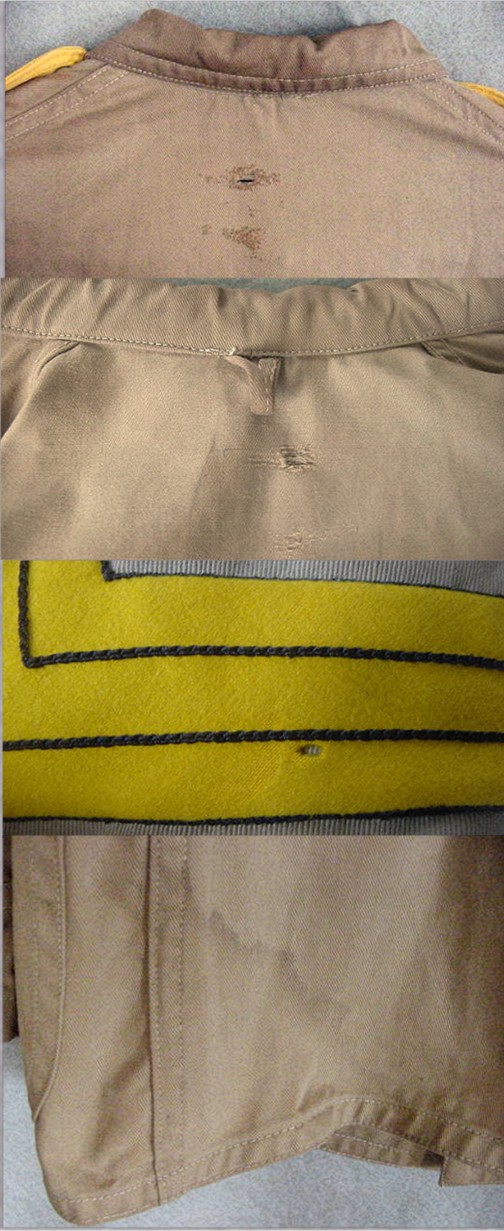
There is only one
significant flaw to the khaki material – two wear
points, one above the other, on the upper back between
the shoulder blades, which are shown in the photographs
below.
All of the matching original
General Service buttons are present on the front
closure, the shoulder straps, and the pocket flaps. The
bottom edge of the blouse is intact without any of the
characteristic fraying normally seen on these blouses
which saw use in the field.
This blouse shows very little soiling. There is a water
(?) stain at the bottom of the blouse over the left rear
hip, and another similar stain below the chevron on the
left sleeve.
Both of these stains are very
light, virtually unnoticeable when the blouse is on
display, and only included here in the spirit of a
complete description.
The matching cavalry quartermaster sergeant’s chevrons
are intact on the sleeves, are in full form, and retain
a bright vivid color. The only wear evident is one moth
nip on the left sleeve chevron on the lower rear
stripe. The shoulder tabs likewise retain their vivid
yellow color with both tabs retaining their full form,
showing no significant wear, and still firmly held in
place by the integral wire hooks. The chevrons and the
shoulder tabs all appear to be original to this blouse.
Introduced as our army was deployed to far away lands
and subjected to the sweltering heat of the Caribbean
and Pacific, this Pattern 1899 Tropical Uniform Blouse
shows some evidence of the cavalry sergeant’s service,
but nonetheless, it has survived in very nice condition
and given the scarcity of these tropical uniforms, it
will be a particularly nice addition to your Spanish
American War display.
(0576)
$1675
NOTE:
To say that photographing uniforms is a challenge is an
understatement. In normal lighting, the cloth absorbs
the light and none of the finer features or condition
details can be seen clearly. In order to highlight the
features and provide you with an accurate view of the
material, I have to lighten the contrast of the
photograph which in turn causes even colored cloth to
appear faded or discolored when such is not the case.
This uniform has an even khaki color throughout as is
seen in the close up photographs.
|