|
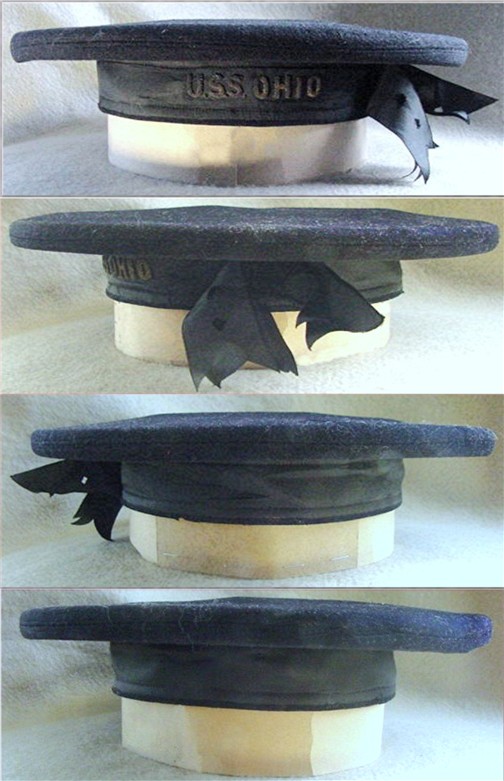
PATTERN 1883 US NAVY ENLISTED “FLAT HAT” – EARLY
EMBROIDERED BULLION SHIP’S TALLEY - BATTLESHIP “USS
OHIO” BB-12 (ca. 1904) – EXCELLENT CONDITION SPECIMEN
FROM THE DAYS OF THE GREAT WHITE FLEET: A very
special offering, this Pattern 1883 US Navy Enlisted
Man’s Dress Blue “Flat” Hat is in excellent condition
and it is embroidered in gold bullion thread with the
name of the sailor’s ship – the USS Ohio, a
pre-dreadnought battleship of the Great White Fleet Era.
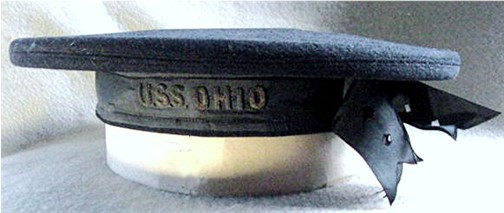
The Enlisted Man’s Dress Hat – also known as the “Flat
Hat” – was based on a general style which had been in
use since the early days of the United States Navy. The
earliest reference to the flat hats appears in the
writing of a Naval surgeon where he observed, “…a
small round hat, varnished to make it waterproof, with
the name of the ship to which the sailor belongs printed
on the front or the letters N.U.S. on a band….”.
In 1833 the service published Navy Uniform Regulations
as they began to standardize the uniform for seamen and
petty officers. In the years to follow through the
Civil War, the hats still showed considerable
individuality in dimension, form to some degree, and
decoration due in part to the navy not having the same
structured system of uniform design, manufacture and
supply as that of the army. One notable characteristic
of these earlier hats was that at least some sailors
were conscious of proportion, making or tailoring their
hats relative to the size of their heads or overall body
size, resulting in considerable variations in the
diameter of the crowns and the height of the sides from
sailor to sailor. As the flat hats were soft, the
sailors were prone to customize them by adding
stiffeners to the rim of the crown or filling the crown,
in some cases almost pillow-like in appearance, to
personalize the shape.
During the CW, the practice emerged of painting the
ship’s name (without the “USS”) in gold paint on the
talley - the ribbon around the hat. Later in the War,
there were some instances of entire crews having their
ship’s name embroidered on the talley in gold bullion.
The first record of the ribbon being required on the
enlisted man’s cap appeared in 1866 when the band was
prescribed to be a black ribbon with the ship’s name in
gold letters. The publication Uniform for the United
States Navy, 1869 described the ribbon, “The
lettering is to be of gilt or yellow color and must be
the same in character and size for the whole ship’s
company.” The U.S. Navy Uniform Regulations,
1886, describes the ribbon to have “the name of
the vessel ... in plain block letters one-half inch in
height, preceded by the letters U.S.S. will be woven in
gilt thread through the center of the ribbon.” The
regulations published in 1899 and 1905 provided this
same description.
As for the pattern of the hat, it
wasn't until the publication of the US Navy’s 1883
Uniform Regulations that the Enlisted Dress Hat, as it
came to be known in official publications, took on a
standard shape and size (diameter of the crown) and the
talley took on the familiar form. It became the
standard issue for enlisted men below the rank of chief
petty officer and it remained so, virtually unchanged
throughout its service life.
With the entry of the United
States into World War One, the practice of embroidering
or printing the name of the ship on the talley was
discontinued as a cost saving measure due to the expense
and challenge of keeping the sailors supplied with the
correct named talleys as the ranks swelled and the
numbers of ships increased in the mobilization for war.
For the duration of the war, the talleys were printed
with the generic "US NAVY", however in 1920 the Navy
returned to printing the ship’s name or the name of
several different shore stations on the talleys. Those
sailors not attached a specific ship or command wore
talleys with the “US NAVY” legend. In 1941 the Navy did
away with the ship and command named talleys and
prescribed the “US NAVY” printed talley for all the
Dress Hats.
Even after the white cotton "Dixie
Cup" hat was allowed to be worn during the winter months
and with the dress uniform, soon displacing the flat hat
in popularity and common use among the sailors, the flat
hat continued to be issued to each sailor until it was
withdrawn from the uniform inventory in 1963. Some
credit its 80 years of continuous service as the longest
serving general issue uniform item in the history of the
US Military.
This Pattern 1883 Enlisted Dress Hat has survived in
very nice condition, showing only very minimal evidence
of wear or ill affects from poor storage. The hat is
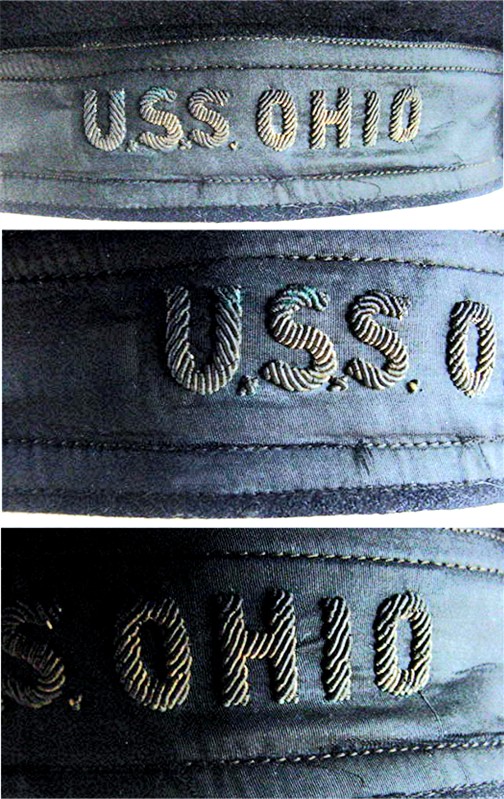
full form with all the seams intact. The talley is full
length and form with no tattering along the edges and it
is embroidered in gold bullion thread with the name of
the sailor’s ship, “USS OHIO”. The embroidery is
complete with no missing or pulled threads, and the
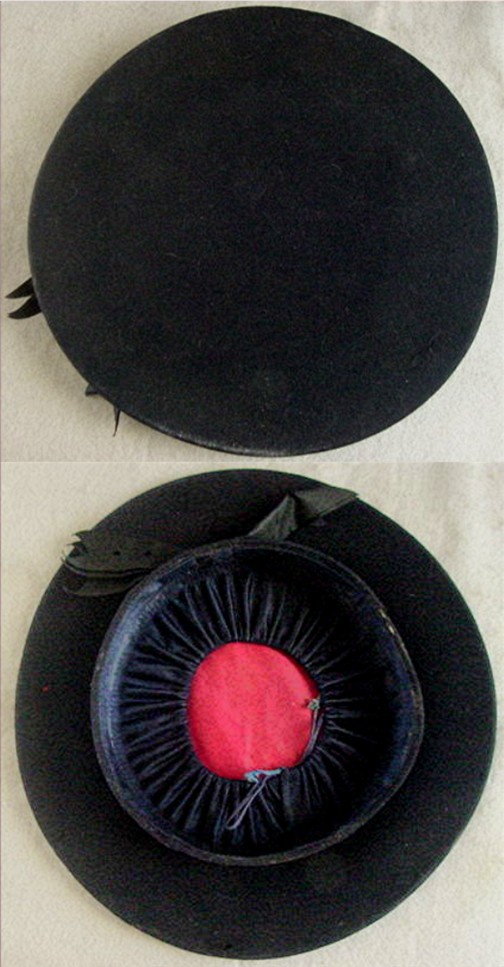
bullion has a nice naturally aged patina. The interior
is in likewise very nice condition with a fully intact
sweat band, red satin crown lining and the dark blue
interior adjustment liner with the full length
drawstring intact. The size label is still present on
the sweat band. The blue wool is in overall very good
to excellent condition with only a very few moth nips.
The interior edge of the crown is fitted with a flat
steel stiffening ring, a typical feature of these early
production hats which served to hold the hat’s shape.
The ends of the talley have a pair of holes apparently
intentionally burned through all the loose ends, all
oriented in the same position on the ribbon. Why this
was done is left to mystery and while there must have
been a reason for it, the sailor left no explanation.
The holes are certainly not random damage, but rather
very purposefully done.
USS OHIO HISTORY
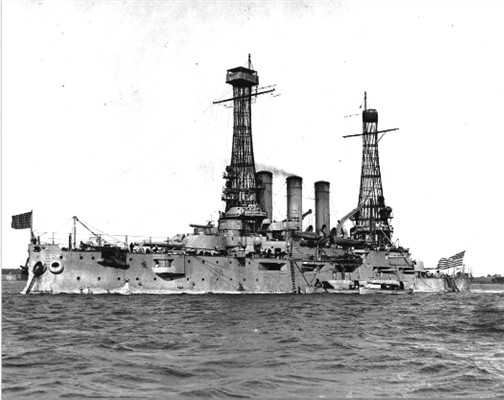
USS OHIO
CA. 1904
The United States Congress funded a major naval
construction program in response to the outbreak of the
Spanish–American War in 1898 which included three new
pre-dreadnought battleships that would become
collectively known as the “Maine class”. The class
incorporated several significant technological
developments, including smaller caliber main guns that
used smokeless powder to achieve greater muzzle velocity
(and thus penetrating power), Krupp cemented armor that
was stronger than Harvey armor used on earlier vessels,
and water-tube boilers that provided more power for the
engines. Her keel laid on April 22, 1899, and built at
the Union Iron Works in San Francisco, the USS Ohio
(BB-12) was the third ship of her class and the third
ship of the United States Navy to be named for the 17TH
state.
Ohio was 393’ 11” inches long, had a beam of 72’ 3”, a
draft of 24’ 4”, displaced 12,723 long tons as designed,
and up to 13,700 long tons at full load. She had a crew
of 561 officers and enlisted men, which increased to 779
and then 813 at various times. Powered by two-shaft
triple-expansion steam engines (rated at 16,000
horsepower) driving two screw propellers, the steam
plant consisting of twelve coal-fired boilers, the
propulsion system delivered a top speed of 18 knots.
The ship was armed with a main battery of four 12” /40
cal. guns in two twin gun turrets on the centerline, one
forward and one aft of the superstructure. The
secondary battery consisted of sixteen 6”/50 cal. Mark
6 guns, placed in casemates in the hull. For
close-range defense against torpedo boats, she carried
six 3”/50 cal. guns mounted in casemates along the side
of the hull, eight 3-pounder guns, and six 1-pounder
guns. As standard for capital ships of the period, Ohio
carried two 18” torpedo tubes, set in her hull below the
waterline on the broadside.
Launched on May 18, 1901 and commissioned October 4,
1904, Ohio was assigned as the flagship of the Asiatic
Fleet. She left San Francisco on April 1ST,
bound for Manila where then-Secretary of War William
Howard Taft and his party boarded for a tour of East
Asia, including Japan and China. Returning to the
United States in 1907 and transferred to the Atlantic
Fleet, she joined the other Atlantic Fleet battleships
on December 16TH in a naval review for
President Theodore Roosevelt in Hampton Roads, Virginia
to mark the start of the cruise of the Great White
Fleet. The cruise of the Great White Fleet was
conceived as a demonstration of American military power,
particularly to Japan. Tension developed between the
United States and Japan after the latter's victory in
the Russo-Japanese War in 1905, and was further fueled
by the combined opposition to Japanese immigration to
the United States and calls for war by the press in both
countries. Roosevelt intended this demonstration of
naval might to deter Japanese aggression. Over the
course of two years, the Great White Fleet
circumnavigated the globe, traveling 46,729 nautical
miles.
The quiet years which followed the grand cruise were
relatively mundane for the Ohio. She home ported in New
York harbor, serving in a routine training capacity. In
1914 she was deployed for a short period into Mexican
waters to protect American interests threatened by the
Mexican Civil War. She returned home to the east coast
of the United States where she was transferred to the
Reserve Fleet based in Philadelphia, being periodically
returned to service to conduct summer cruises for
midshipmen from the US Naval Academy. When the United
States declared war on Germany in 1917, the Ohio was
recommissioned on April 24TH, based in
Norfolk, where she provided training to crews for the
rapidly expanding wartime fleet. Following the end of
the war in 1918, she was sent to Philadelphia on
November 28TH and decommissioned, remaining
there until January 7, 1919, when she was placed back in
reserve.
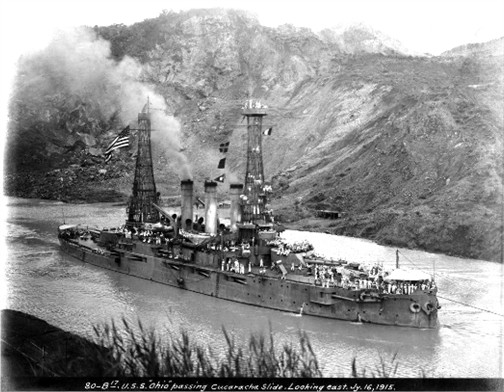
USS OHIO
TRANSITING THE PANAMA CANAL 1918
Her final chapter may very have proven to be one of her
most interesting – that of being recalled from the
reserve fleet to serve as the control ship for the Coast
Battleship Iowa which had been converted into a
radio-controlled target ship. The Ohio trailed the
Iowa, controlling the Iowa’s steerage and propulsion, on
a voyage from Philadelphia to Hampton Roads for a series
of tests beginning in August of 1920. In June of 1921,
the Navy and Army conducted a series of bombing tests
off the Virginia Capes to evaluate the effectiveness of
aircraft against warships, during which Ohio controlled
the Iowa during the experiments, steaming astern of the
target ship along with several other vessels to simulate
a fleet underway. The ability of the target ship to
maneuver added significantly to the challenges faced by
the aircrews in locating and attacking the vessel.
Following the 1922 Washington Naval Treaty, which
mandated significant reductions in naval armaments held
by the leading nations of the world, the USS Ohio was
stricken from the naval register on May 31, 1922 and
sold for scrap on March 24, 1923.
This is a very special example of an early 20TH
Century Pattern 1883 US Navy Enlisted Man’s Dress hat,
very likely worn during the historic cruise of the Great
White Fleet, and identified to one of the earliest
battleships in the fleet. This one has all the
desirable features and would never need to be upgraded.
(0597) $300
|