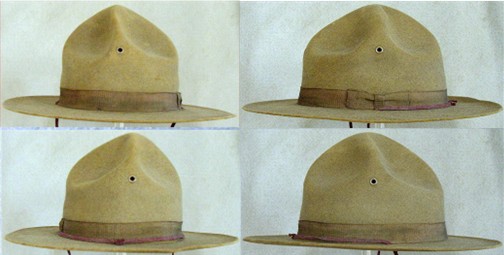
|
PATTERN 1912 CAMPAIGN HAT – EXCELLENT CONDITION
WITH A LEGIBLE MAKER’S AND CONTRACT DATE STAMP - 1916:
In general form, this style of campaign hat was first
introduced with the new uniform regulations published in
1902. Through the ensuing years, the basic pattern was
subjected to several different changes which serve to
date these surviving specimens. While the campaign hat
retained the same basic size and shape, the small
alterations in the details and features were in response
to how the hat served and survived in the field. To my
knowledge, five separate sets of specifications, each
annotating changes in the design, dimensions, and
features for the Pattern 1912 Campaign Hat, were issued
between 1912 and 1918. These changes were important
enough for the army to incorporate and publish, however
hats produced under prior specifications certainly
remained in service as long as they were presentable and
serviceable. The army was a close adherent to “waste
not, want not.”
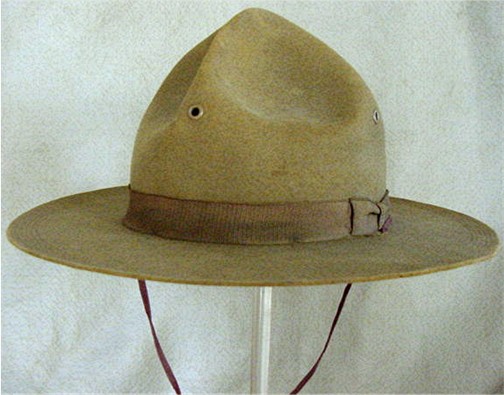
This particular Pattern 1912 Campaign Hat includes
features which are most closely detailed in
Specification No. 1177 which was adopted on April 10,
1913:
1. The crown was extended 1/4 inch
to 5 3/4 inches high, to allow for better air
circulation inside of the hat.
2. The four ventilation eyelets were each raised by
1/4 inch making them 3 inches from the base of the
crown.
3. The edge of the 3 inch wide brim was reinforced
with five rows of silk stitching.
4. The location of the eyelets for the flat braided
tying cord remained 1 1/4 inches forward of the
crown's center point; however, they were moved to the
base of the crown and under the sweatband.
This hat includes the above
features, however it also features one detail from the
previous Specification No. 1145 which had been adopted
on January 2, 1912, that called for two slits in the
brim – one on each side the crown, ¼” from its base –
through which the flat braided tying cord was passed.
This hat has both the slits from this previous
specification and the eyelets called for in
Specification No. 1177.
This presence of both means of
securing the tying cord is a good example of the
challenges faced by the civilian manufacturers who
produced uniform items of all kinds, to include these
hats, under the contracts with the army. While each
change in the specifications was communicated by the
army to the manufacturers, as the changes were being
considered, decisions made, the specifications written
and communicated to the makers, the employees of uniform
companies were continuing to cut the cloth to the
pattern at hand, assemble the pieces at the sewing
machines, attach the buttons, labels and complete any
handwork necessary, and pack the finished pieces for
shipment. Fortunately, the army was understanding and
as long as the contractors made a good faith effort to
stick to the patterns and specifications they had, and
were agreeable to making the changes as they were handed
down, the army continued to accept pieces made in the
previous patterns. If they hadn’t worked with the
contractors, the contractors would have long since given
up and walked away from the frustration of the changes,
leaving the army without the uniforms necessary to
clothe their ranks.
This hat has survived the passage of time in very good
to excellent condition. It is clean with no significant
soiling, has retained its body and shape, and while
showing evidence of having been worn, was not subjected
to any abuse or rough wear. The crown is full form,
retaining the crisp peak. All of the ventilation
eyelets are present and firmly in place. There are no
breaks or cracks in the felt. The brim is in overall
excellent condition with none of the characteristic
breaks in the edge of the felt. The satin hat band is
present and in full form with the proper flat bow and
without any tattering to the edges. The edge of the
brim still retains the five rows of stitching which were
incorporated to stiffen the brim and support the edge.
The sweat band is present
in full form with no tearing, the ribbon tie at the back
is still present, and the underside of the band is
legibly ink stamped with the contractor’s name and
contract date of 1916. The leather band shows some
darkening from wear, but it still retains a russet color
and the leather is still pliable. The original brown
cotton flat braided tying cord is present and full
length. The only sign of wear or age is a few spots of
very light moth tracking on the under side of the brim,
so light that they would not show up in the
photographs. Hardly noticeable except on very close
inspection, I only mention them here in the interest of
a full description.
This is an excellent example which
has survived the years in very nice condition, and one
that would fit quite well with a Punitive Expedition and
World War One grouping.
SOLD
|